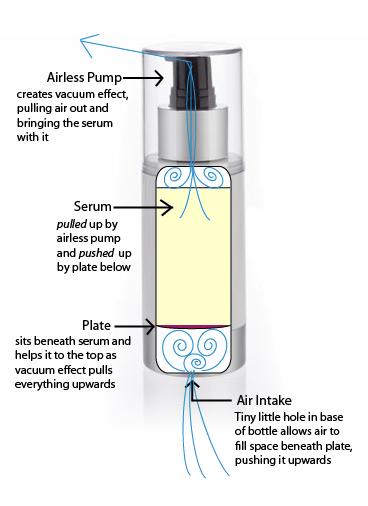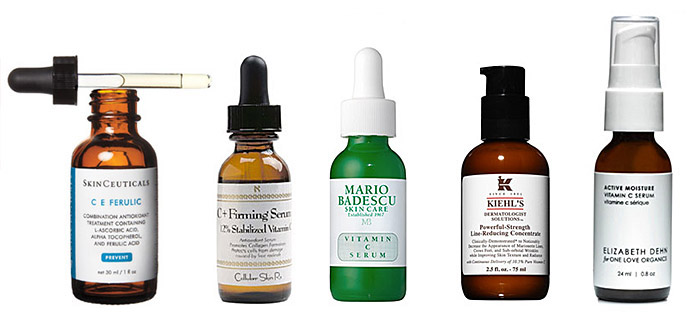
As I mentioned a few times in the DIY thread, I intended to create my own Vitamin C serum since a while. I actually bought all the ingredients needed a while ago (last summer), but didn't take the time to create/test my own serum; in fact, I wanted to make sure to have enough free time to read about it a bit more and make small adjustments if needed. I finally created a small batch this weekend and thought I'd share the complete procedure. The serum presented here is essentially a powerful combination of vitamin C, vitamin E and ferulic acid, hence the name C E Ferulic serum. This formulation is patented by SkinCeuticals (US patent number: 20050154054), and the only other way you could obtain it is to pay $157 for a small bottle of 30ml; in this thread, I'll show you how to reproduce a much similar serum for a fraction of the price.
A few facts...
First of all, the central ingredient of this serum is vitamin C; vitamin E and ferulic acid are only added to make it more effective. But what makes vitamin C so special, you might ask? Here are a few facts about vitamin C established by the scientific community:
Quote by ]Vit. C as antioxidant
Vit. C, the most plentiful antioxidant in human skin, forms a part of the complex group of enzymatic and non-enzymatic antioxidants that co-exist to protect the skin from reactive oxygen species (ROS). As Vit. C is water soluble, it functions in the aqueous compartments of the cell.[4] When the skin is exposed to UV light, ROS such as the superoxide ion, peroxide and singlet oxygen are generated. Vit. C protects the skin from oxidative stress by sequentially donating electrons to neutralize the free radicals.
UVA mutates and destroys collagen, elastin, proteoglycans and other dermal cellular structures.[2] Thus, UVA causes skin ageing and possibly melanoma formation. UVB causes sunburn, ROS, epidermal mutations and skin cancer. Sunscreens when properly applied prevent UV-induced erythema and thymine dimer mutations that contribute to cutaneous carcinogenesis. However, sunscreens block only 55% of the free radicals produced by UV exposure.
Antioxidants are necessary for neutralizing the ROS formed due to UV exposure.[2] To optimize UV protection, it is important to use sunscreens combined with a topical antioxidant. Vit. C does not absorb UV light but exerts an UV-protective effect by neutralizing free radicals, while this effect is not seen with sunscreens. Under laboratory conditions, it has been shown that application of 10% topical Vit. C showed statistical reduction of UVB-induced erythema by 52% and sunburn cell formation by 40-60%.[3]
Vit. C and collagen synthesis
Vit. C is essential for collagen biosynthesis. It has been proposed that Vit. C influences quantitative collagen synthesis in addition to stimulating qualitative changes in the collagen molecule.[2] Vit. C serves as a co-factor for the enzymes prolysyl and lysyl hydroxylase, the enzymes that are responsible for stabilizing and cross-linking the collagen molecules.[2] Another mechanism by which Vit. C influences the collagen synthesis is by stimulation of lipid peroxidation, and the product of this process, malondialdehyde, in turn stimulates collagen gene expression.[2]
Vit. C also directly activates the transcription of collagen synthesis and stabilizes procollagen mRNA, thereby regulating collagen synthesis.[2,3] Signs and symptoms of Scurvy, a deficiency disease of Vit. C, are due to impaired collagen synthesis. Clinical studies have shown that the topical use of Vit. C increases collagen production in young as well as aged human skin.[3,6]
Vit. C as a depigmenting agent
When choosing a depigmenting agent, it is important to differentiate between substances that are toxic to the melanocyte and substances that interrupt the key steps of melanogenesis. Vit. C falls into the latter category of depigmenting agents. Vit. C interacts with copper ions at the tyrosinase-active site and inhibits action of the enzyme tyrosinase, thereby decreasing the melanin formation.
Anti-inflammatory action of Vit. C
As stated earlier, Vit. C inhibits NFkB, which is responsible for the activation of a number of pro-inflammatory cytokines such as TNF-alfa, IL1, IL6 and IL8.[2,3] Therefore, Vit. C has a potential anti-inflammatory activity and can be used in conditions like acne vulgaris and rosacea. It can promote wound healing and prevent post-inflammatory hyperpigmentation.[2,3]
However, there's a catch: vitamin C is rather unstable and oxidizes within a few days/weeks. Once it has oxidized (the solution will turn yellow/brown), vitamin C won't provide any of its benefits to the skin and might even become irritating and detrimental. Furthermore, the concentration of vitamin C needs to be rather high to be any effective, somewhere between 5-20%. This essentially means that vitamin C products available on the market are rarely of any use: their concentration will either be too low to show benefits, or you'll pay a rather high-price for a product that will have a limited shelf-life of only a few weeks (even the aforementioned $157 serum by SkinCeuticals only lasts about a month). Hence why going the DIY route is a smart choice in this specific case: you'll be able to create small inexpensive batches that will be just as effective as high-end products for a fraction of the price.
Quote by [url=http://www.smartskincare.com/treatments/topical/vitc.html
Smartskincare.com]There are, however, some complicating circumstances often disregarded by manufacturers. In particular, ascorbic acid, the principal natural form of vitamin C, is relatively unstable (unless it is in a dry form). In the presence of air or other oxidizing agents, it undergoes oxidation.
A number of skin care companies offer highly concentrated stabilized vitamin C products, which (at least in theory) are supposed to be consistently effective. However, these products are usually quite expensive. Furthermore, even stabilized vitamin C products may be at least somewhat degraded by the time you use them.
Vitamin E and ferulic acid are added to the already potent vitamin C base for two main reasons. First, they both greatly enhance the effects of vitamin C. Second, they help render the vitamin C more stable, which works brilliantly to extend the shelf-life of your homemade serum.
Quote by ]Although Vit. C alone can provide photoprotection, it works best in conjunction with Vitamin E (Vit. E), which potentiates the action of Vit. C four-fold. Hydrophilic Vit. C helps regenerate Vit. E, a liphophilic antioxidant.[1,3,5,6] Thus, Vit. C and Vit. E together protect the hydrophilic and lipophilic compartments of the cell, respectively. Vit. C and Vit. E synergistically limit chronic UV damage by significantly reducing both cell apoptosis and thymine dimer formation.[3,6]
A combination of 0.5% ferulic acid (a potent antioxidant of plant origin) with 15% Vit. C and 1% Vit. E can increase the efficacy of Vit. C eight-fold.[3] It was noted that this triple combination was very useful for the reduction of acute and chronic photodamage, and could be used for prevention of skin cancer in the future.[3]
A few other considerations:
- The higher the concentration of vitamin C, the more potent (but also more irritating) the serum will be; maximal efficiency is reached at a concentration of 20%.
- The serum needs to be acidic enough to penetrate the skin; only solutions with a pH below 3.5 are proven to be effective.
- Even with the addition of vitamin E and ferulic acid, the vitamin C will still eventually oxidizes. Your serum should be handled/stored properly to extend its shelf-life.
Okay, that's a lot of science and considerations, but in this guide I'll show you how to create an inexpensive serum that will provide all the aforementioned benefits while respecting every condition to make it safe/reliable. However, try to respect these instructions as closely as possible, otherwise you might end up with an ineffective (or even harmful) product; for example, don't swap the ingredients or change their proportions at will, everything presented here serves a very specific purpose.
What you'll need...
First of all, here's what you'll need. Most of these ingredients can be bought online at [url=http://www.lotioncrafter.com]www.lotioncrafter.com for a very cheap price:
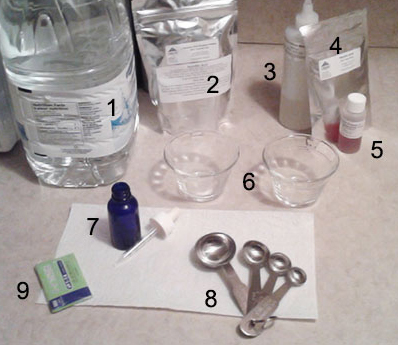
1- Distilled water. DO NOT USE TAP WATER, this will oxidize your vitamin C very rapidly. You can buy a large bottle at any grocery store for a very cheap price.
2- L-Ascorbic Acid (vitamin C). Can be bought here. Recommended order: 8 oz ($29.95).
3- 50/50 mix of propylene glycol and glycerin. Can be bought separately here and here. Recommended order: 8 oz ($4.00) / each.
4- Ferulic Acid. Can be bought here. Recommended order: 25g ($15.95).
5- Mixed Tocopherols T50 (vitamin E). Can be bought here. Recommended order: 1 oz ($6.85).
6- Two small bowls (preferably in glass/plastic).
7- Cobalt bottle 30ml (1 oz), or any other opaque container to store your serum properly. Can be bought on Amazon. ($5.95 for 6).
8- Measuring spoons.
9- PH strips. Can be bought on Amazon. ($1.82 for 160).
10- Not shown here, optional (though highly recommended): Polysorbate 80. Can be bought here. Recommended order: 4.5 oz ($3.75).
Note: I'll explain further in this guide why buying Polysorbate 80 might be a good idea (I didn't have it on hand myself when mixing my serum).
You should be able to buy all of these for only around $70 (+shipping). With the recommended quantities, you'll be able to create x20 bottles of 30ml (1 oz). That's nearly $3,200 worth of Skinceutical's C E Ferulic serum that you'll be able to make for a fraction of the price.
Creating your own serum...
After making sure that your working surface and accessories are perfectly clean, here's how you should proceed:
*Important notice: I modified quite a few steps since I originally posted this recipe. You can check my latest posts for an improved version of this serum.*
Bowl #1
- In the first bowl, pour 3-1/2 tsp of distilled water.
- Add 1 tsp of L-Ascorbic Acid (vitamin C) and stir gently. The powder from LotionCrafter is very fine, it will dissolve perfectly in about 5-10 seconds.
Note: 1 tsp of L-Ascorbic Acid will create a serum of 15% vitamin C. If you fear this might be too irritating at first, you could use slightly less, anywhere between 1/2 and 1 tsp (7-15% final concentration).
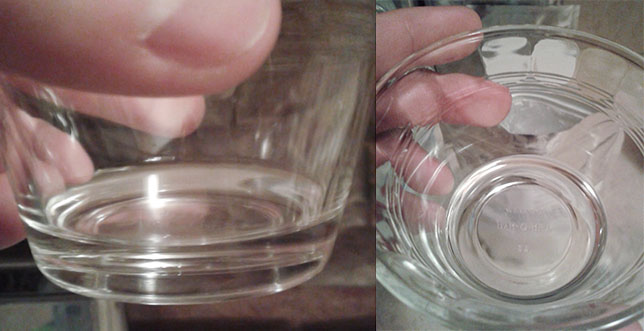
This is the dissolved solution; note how perfectly clear it is.
Bowl #2
- In the second bowl, pour equal parts of propylene glycol and glycerin, for a total of 2 tsp (1 tsp of each). You could also mix the two in equal parts preemptively in a bigger container and simply pour the desired quantity.
- Add 1/8 tsp of Ferulic Acid (that's half a measure of 1/4 tsp) and stir until dissolved. Ferulic Acid only dissolves in propylene glycol, don't try to dissolve it in water. You could also add a bit more propylene glycol (up to 1/2 tsp) if you have a hard time dissolving it.
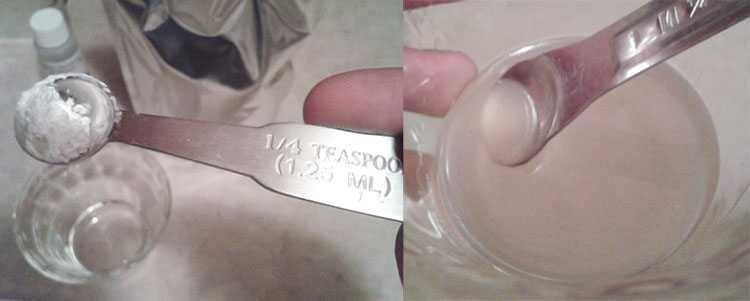
Your solution will have a whitish tint when fully dissolved, this is perfectly normal.
- When the Ferulic Acid is fully dissolved, add 1/4 tsp of Mixed Tocopherols T50 (vitamin E) to the same bowl; also add 1/4 tsp of Polysorbate 80 if you have access to it.
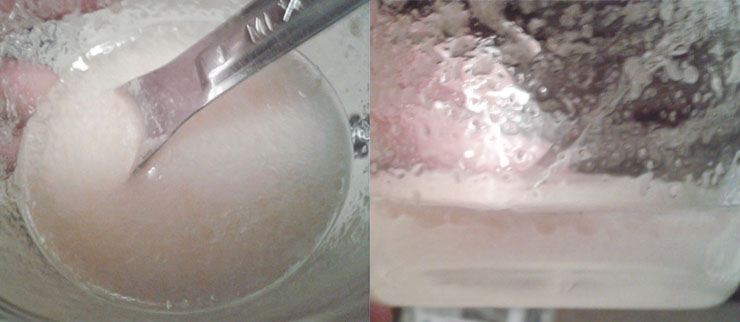
As you can see, dissolving an oil (vitamin E) in another base is rather difficult. Polysorbate 80 is an emulsifier which will greatly help you obtain a nice homogeneous solution. If you don't use Polysorbate 80, you'll have to shake your bottle every time before applying your serum (which can accelerate the oxidation of vitamin C).
Final mix
- When both of your bowls are ready, pour the content of the first bowl into the second and stir gently. At this point, the ingredients will likely already be fully dissolved, you'll only need to mix the two preparations together.
- Transfer the final mix into your opaque container (eg. cobalt bottle).
- You should now test the pH of your serum, this is extremely important: a pH below 2.5 will be too acidic/irritating, while a pH above 3.5 will be completely ineffective. Ideally, you should obtain a pH of around 3.0.
Note: Coca-Cola has a pH of 2.5, so this serum (if mixed properly) isn't as acidic/irritating as you might think.
Here's how my own serum turned out:
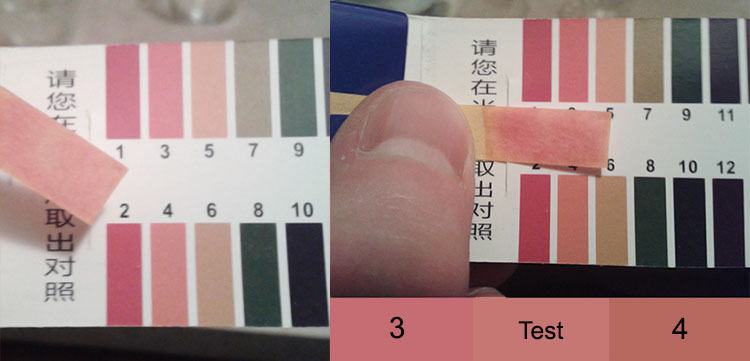
As you can see the strip has an orangey color, definitely somewhere between a pH of 3.0 and 4.0. With the help of Photoshop, I extracted the colors on this picture to analyze them more efficiently (shown in the lower-right corner). You'll notice that the color of the strip (ie. Test) is closer in tint to 3.0 than to 4.0; the separation with the 3.0 zone is a lot less clear than with the 4.0 zone. My guess for my serum is a pH of around 3.2, exactly what I was aiming for. Perfect! You should also obtain a similar pH if you follow these instructions closely, but I'd still recommend to test the pH of your own serum.
Congratulations, you now have a fantastic cosmetic product! Seal it properly and store it in a dark/cool place, preferably in your refrigerator.
This bottle should last you a few weeks, discard it as soon as the solution turns yellow/brown: by then, the vitamin C will have oxidized and your serum will be ineffective. You can create a new batch whenever you want, though it is always recommended to only mix a small amount at a time not to waste your precious ingredients; 30ml is the ideal amount to make (as instructed in this guide). As I mentioned previously, the suggested purchases will also allow you to mix around 20 bottles of 30ml (that's almost 2 years worth of this serum).
Here are the final proportions of each ingredient, for the scientifically inclined:
- Water, 50%
- L-Ascorbic Acid (vitamin C), 15%
- Propylen glycol, 15%
- Glycerine, 15%
- Tocopherols T50 (vitamin E), 2%
- Polysorbate 80, 2%
- Ferulic acid, 1%
You can also compare to the ingredients of Skinceutical's C E Ferulic serum. You'll likely notice a very strong resemblance:
Water, Ethoxydiglycol, L Ascorbic Acid, Propylene Glycol, Glycerin, Laureth 23, Alpha Tocopherol, Phenoxyethanol, Triethanolamine, Ferulic Acid, Panthenol, Sodium Hyaluronate
Note: Most of the other ingredients are simply solvents/stabilizers to render the solution more homogeneous (eg. Ethoxydiglycol, Laureth 23, Phenoxyethanol, etc.).
How to use this serum...
You can use this serum daily (or twice daily). The usual recommended routine is to apply it in the morning, 10-15 minutes after washing your face not to alter the pH of your serum. Take it out of the refrigerator, shake it a little (only if needed), pour a few drops on your fingers and apply all over your face. It will dry within only a few minutes; you can then apply your sunscreen/makeup and proceed with your day. This serum is barely noticeable once it has dried (no stickiness/irritation), and the longer you'll leave it on your face, the more vitamin C your skin will absorb. It will also increase your protection to UV rays during the day, along with your favorite sunscreen.
Obviously however, discontinue use if you experience any negative reaction (eg. irritation, stinging, rashes, etc.).
Hope you enjoyed and feel free to ask questions!